



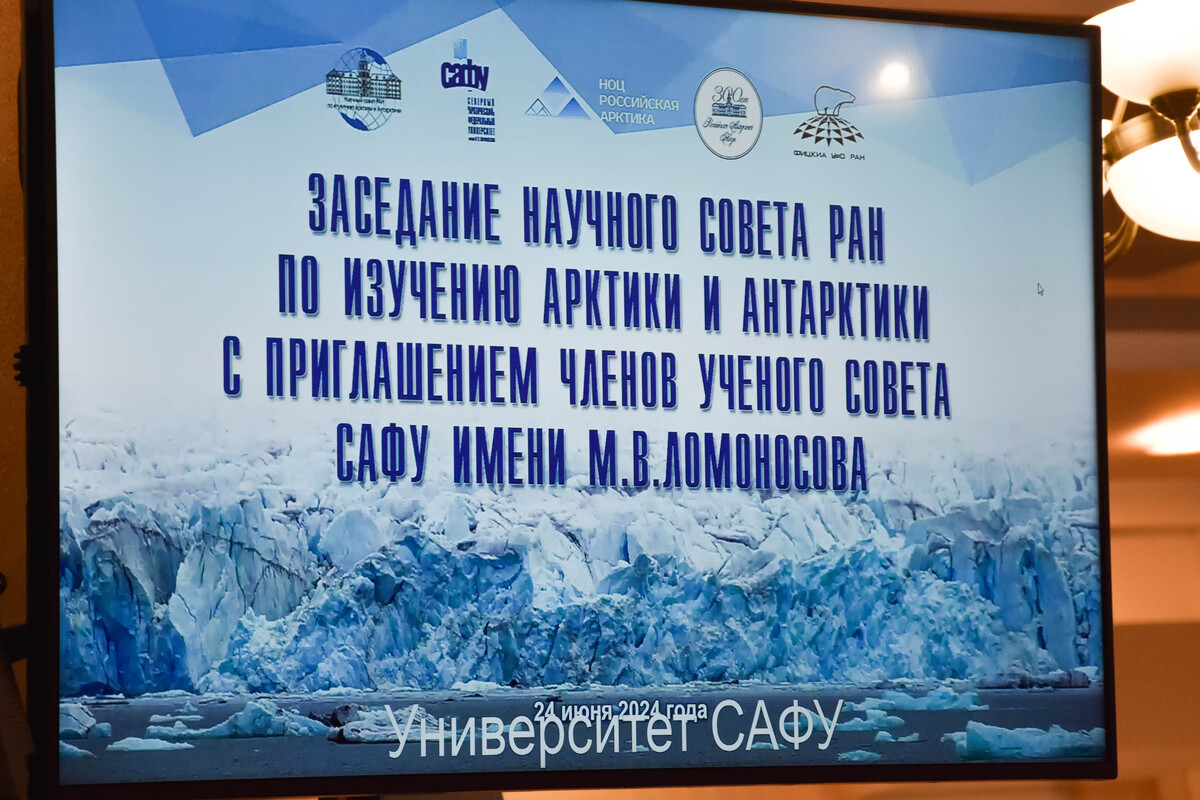
On June 24, an extramural session of the RAS Scientific Council for the Study of the Arctic and Antarctic, of which KarRC RAS Director General Olga Bakhmet is a member, took place in Arkhangelsk. This event, hosted by the Northern Arctic Federal University (NArFU) started with the ceremony of awarding NArFU Professor Emeritus status to Academician Nikolai Kasimov.
The core program was devoted to summarizing the results of the activities of "new materials, technologies and research methods” in 2020-2024. The REC was established as a collaboration between three regions of the Russian Federation: the Arkhangelsk and Murmansk Regions and the Nenets Autonomous District, and a number of organizations from other regions, including KarRC RAS, are REC partners. The center's activity areas include the study of biological resources of the Arctic, human life, development of high-tech industries, mining, development of the Northern Sea Route, materials and shipbuilding technologies, and others.
The activities of the research and education center were discussed by the council members and a number of NArFU employees. Presentations at the conference were made by representatives of organizations that cooperate with the Russian Arctic REC.
— Karelian Research Centre RAS is a partner of the Russian Arctic REC. I would like to highlight such important joint projects as scientific substantiation of the need to use biological substances in post-COVID-19 recovery; assessment of the expediency of enriching the diet of Arctic zone residents with biologically active natural adaptogenic substances; extracts of Arctic brown algae as biostimulants of plant growth and development; timber quality and safety of northern forests under climate change; the potential of using wastes from the pulp and paper industry in agriculture; research on the methods and technologies for preserving unique genotypes of major coniferous and deciduous species in vitro. As a council member, I participated in the discussion of REC's work aspects: how the projects are organized, the work progress. As for the shortcomings, I noted the late allocation of funding for research projects. I also proposed to arrange an annual discussion of the results obtained in certain areas, for example, biological and Earth sciences, — Olga Bakhmet remarked.
Session participants were given a tour of NArFU's new labs, including youth labs, and were introduced to the opportunities the university offers for third-party organizations.
Members of the RAS Scientific Council for the Study of the Arctic and Antarctic favorably appraised the activities of the Russian Arctic REC.
KarRC RAS
in social media


in social media
News
July 8, 2024
Activities of the Russian Arctic Research and Education Center discussed in Arkhangelsk
Extramural session of the RAS Scientific Council for the Study of the Arctic and Antarctic took place at the Northern Arctic Federal University (NArFU). The Council gathered to discuss the activities of the Russian Arctic Research and Education Center (REC). KarRC RAS Director General took part in the discussion.
Extramural session of the RAS Scientific Council for the Study of the Arctic and Antarctic took place at the Northern Arctic Federal University (NArFU). The Council gathered to discuss the activities of the Russian Arctic Research and Education Center (REC). KarRC RAS Director General took part in the discussion.
See also:

November 16, 2026
Scientists in Karelia patent a method for measuring morning activity in schoolchildren
Scientists of the Institute of Biology KarRC RAS, assisted by the Centre's patent service, have developed and patented a method for measuring the morning physical activity peak in children aged 7–16. It combines genetic analysis with questionnaire surveys of schoolchildren and can be leveraged to tailor academic and training exercise loads to the child's individual characteristics.
Scientists of the Institute of Biology KarRC RAS, assisted by the Centre's patent service, have developed and patented a method for measuring the morning physical activity peak in children aged 7–16. It combines genetic analysis with questionnaire surveys of schoolchildren and can be leveraged to tailor academic and training exercise loads to the child's individual characteristics.

November 13, 2026
The film "Karelian Research Centre RAS: the Past, the Present, the Future" premiered on media platforms
The "Karelian Research Centre RAS: the Past, the Present, the Future" documentary, produced for the 80th anniversary of the KarRC RAS, is now available online. Previously, it was TV-premiered on the OTR and Sampo TV 360 channels. The film relates the history and evolution of academic science in Karelia, tells about the work of researchers and research units, and introduces the prospects for the development of the Centre.
The "Karelian Research Centre RAS: the Past, the Present, the Future" documentary, produced for the 80th anniversary of the KarRC RAS, is now available online. Previously, it was TV-premiered on the OTR and Sampo TV 360 channels. The film relates the history and evolution of academic science in Karelia, tells about the work of researchers and research units, and introduces the prospects for the development of the Centre.

November 13, 2026
We congratulate Zakhar Slukovsky, Senior Researcher at the Laboratory of Quaternary Geology and Geoecology of the Institute of Geology KarRC RAS, on successful defense of his Doctor of Sciences dissertation!

November 11, 2026
Biochemists experimentally study inflammation-reducing effects of natural feed additives in fish
Scientists at the Institute of Biology KarRC RAS have completed the experimental part of a study assessing the anti-inflammatory properties of natural feed additives. The main study organism is rainbow trout. Within a research project, they examine the inflammatory process dynamics in fish at the biochemical and molecular genetic levels and the mechanisms through which natural additives, such as dihydroquercetin from larch logging waste and tannins from sweet chestnut can influence it. The results of this work will help use less antibiotics in aquaculture
Scientists at the Institute of Biology KarRC RAS have completed the experimental part of a study assessing the anti-inflammatory properties of natural feed additives. The main study organism is rainbow trout. Within a research project, they examine the inflammatory process dynamics in fish at the biochemical and molecular genetic levels and the mechanisms through which natural additives, such as dihydroquercetin from larch logging waste and tannins from sweet chestnut can influence it. The results of this work will help use less antibiotics in aquaculture