
News
September 9, 2025
Aapa mires – a potential joint research interest for scientists from Karelia, Khabarovsk, China

Head of the Mire Ecosystems Laboratory at the Institute of Biology KarRC RAS Stanislav Kutenkov took part in the International Symposium on Conservation and Sustainable Development of Peatland Resources in the Chinese city of Changchun. The laboratory implements studies far beyond Karelia, including the Russian Far East, so there is potential for collaboration with Chinese scientists on comparative mire studies.
International Symposium on the Conservation and Sustainable Development of Peatland Resources took place in Changchun (Jilin Province, China) on August 22–24. Its participants were scientists from China and Russia. Our country was represented by the Head of the Mire Ecosystems Laboratory of the Institute of Biology KarRC RAS Stanislav Kutenkov and specialists from the Institute of the Water and Ecology Problems of the RAS Far Eastern Branch (Khabarovsk) Vladimir Chakov and Viktoria Kuptsova.

Stanislav Kutenkon made two presentations at the symposium. One was about the biodiversity and dynamics of peatland forests in the north of European Russia. In his other presentation the scientist told the audience about the history and lines of research of the Laboratory of Mire Ecosystems at IB KarRC RAS.

The laboratory has been working for as long as 74 years, maintaining an integrated approach and holding a leading position in its sphere within the Russian Academy of Sciences. Its staff study mire vegetation, peat deposits and evolution, investigate the past climates relying on fossils in peat. The scientists take part in the nomination process and monitoring of protected areas. Wetlands are essential for the planet’s carbon cycle: they sequester carbon dioxide and deposit tons of carbon. These aspects are also in the focus of the scientists’ attention. In particular, carbon stocks in mire ecosystems and agricultural landscapes of Karelia are currently being estimated within a key innovative project of state important. Its principal objective is to create a unified national system for monitoring climate-active substances.


Session in progress. Stanislav Kutenkov first row far right. Photo: Northeast Normal University School of Geographical Sciences

The laboratory’s studies reach far beyond Karelia, implemented for instance in the Russian Far East. Previously, Stanislav Kutenkov together with colleagues from the Institute of the Water and Ecology Problems of the RAS Far Eastern Branch made a first finding of aapa mires in the Kharabarovsk Krai and studied them.

– Aapa mires are a most widespread type in Fennoscandia and Kamchatka, but are extremely rare in the mainland Far East, where they hadn’t been known until lately. The surveyed mires are similar to Karelian aapa bogs in having ridge-hollow complexes surrounded by oligotrophic sites with tree-shrub-Sphagnum vegetation. Their vegetation shows high similarity to that of mires in the north of European Russia, but also featuring species specific to the Far East. Eight moss species not previously known for the Khabarovsk Krai were spotted in the aapa mires that we have discovered, – shared Stanislav Kutenkov.

In addition to improving the knowledge of the biological diversity of the Khabarovsk Krai this study provided new information about the Eurasian distribution of aapa mires. The new obtained data will be used when developing the classification of mire vegetation of Russia.

Possibilities for future cooperation between the Northeast Normal University’s School of Geographical Sciences and the Mire Ecosystems Laboratory IB KarRC RAS were discussed during the symposium. Specifically, Chinese colleagues have recently detected similar aapa mires in Northeast China’s mountain regions and their comparative study is of mutual interest. Another potentially interesting area for joint research is investigation of permafrost in peatlands of the Russian Arctic, Far East, and Tibet. In an earlier project funded by the Russian Science Foundation (#22-77-10055, Leader – P. Ryazantsev) Karelian scientists implemented a large study of permafrost-core palsa mires in the Kola Peninsula.


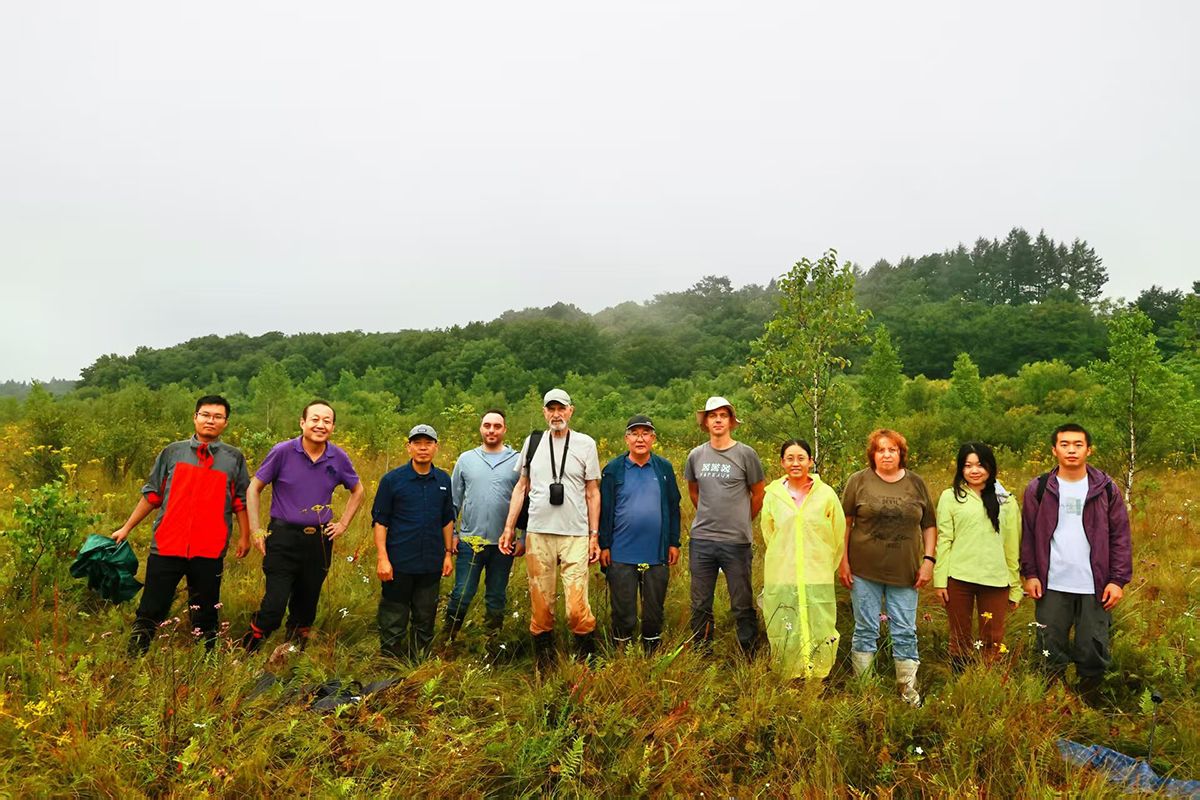
Group photo of Symposium participants. Photo: Northeast Normal University School of Geographical Sciences

As an official outcome of the symposium, scientists from China and Russia have resolved to prepare memorandums to develop international cooperation with the Khabarovsk Federal Research Centre of the RAS Far Eastern Branch and Karelian Research Centre RAS.

Overall, the symposium dealt with the questions of maintaining the ecological functions of peatlands, studying the potential of the deposited carbon, and the application of green resources. The key objective of this international event was to establish a platform for cross-border scientific cooperation and industrial integration.

The symposium was organized by the Northeast Normal University’s School of Geographical Sciences in collaboration with Northeast Institute of Geography and Agroecology of the Chinese Academy of Sciences, Peat Industry Branch of the Chinese Humid Acid Industry Association, and Peatland Society of Jilin Province.

See also:

December 8, 2025
Staff of the Vilga Laboratory presented scientific developments in agritech at the year-end 2025 meeting at Agriculture Ministry

Staff of the Vilga Agrotechnology Laboratory of the Department for Multidisciplinary Research KarRC RAS took part in the session “Results of the agricultural season 2025 and plans for 2026” held in the Village of Ladva. They presented the laboratory’s major research areas and scientific developments.
December 5, 2025
Olga Bakhmet proposed KarRC RAS as the host for the scientific conference on the study of Karelia’s water bodies

Doctor of Biological Sciences Olga Bakhmet took part in a meeting of the Council on Fish and Fisheries Sector Development held in Petrozavodsk on December 2nd. Active participants of the meeting were representatives of the executive and legislative authorities of the Republic of Karelia, scientists, and members of the business community. The meeting focused on prospects for the development of the sector in Karelia, utilization of seaweed resources in the White Sea, increasing production volumes, and introducing new types of products.
December 4, 2025
Project to roll out artificial instream egg incubators wins the Green Prize 2025

The Russian Environmental Operator awarded the winners of the Green Prize 2025. The project recognized as the best in the "Sustainable Practices in the Agricultural Industry" category is "An Integrated Technology with Artificial Nests for Fish Egg Incubation". The devices for the reproduction of young salmonid populations were designed at the Karelian Scientific Center RAS and tested in collaboration with Kola Mining and Metallurgical Company JSC (part of Nornickel). The incubators are being successfully used on rivers in northern Karelia and the Murmansk Region.
December 3, 2025
Literature scholar Alexander Pigin was awarded Makarius’s Prize for his treatise “17th-18th Century Tales of the Kargopol Land”

Leading Researcher of the Institute of Linguistics, Literature and History KarRC RAS Alexander Pigin was awarded The First Prize in Memoriam of Metropolitan Macarius (Bulgakov) of Moscow and Kolomna for his treatise “17th-18th Century Tales of the Kargopol Land. Saints and Sanctities of Chelmogorskaya, Hergozerskaya, Kenskaya and Lebyazhiia Monasteries”. The Macarius Prize is one of the main awards in the humanities in Russia.