



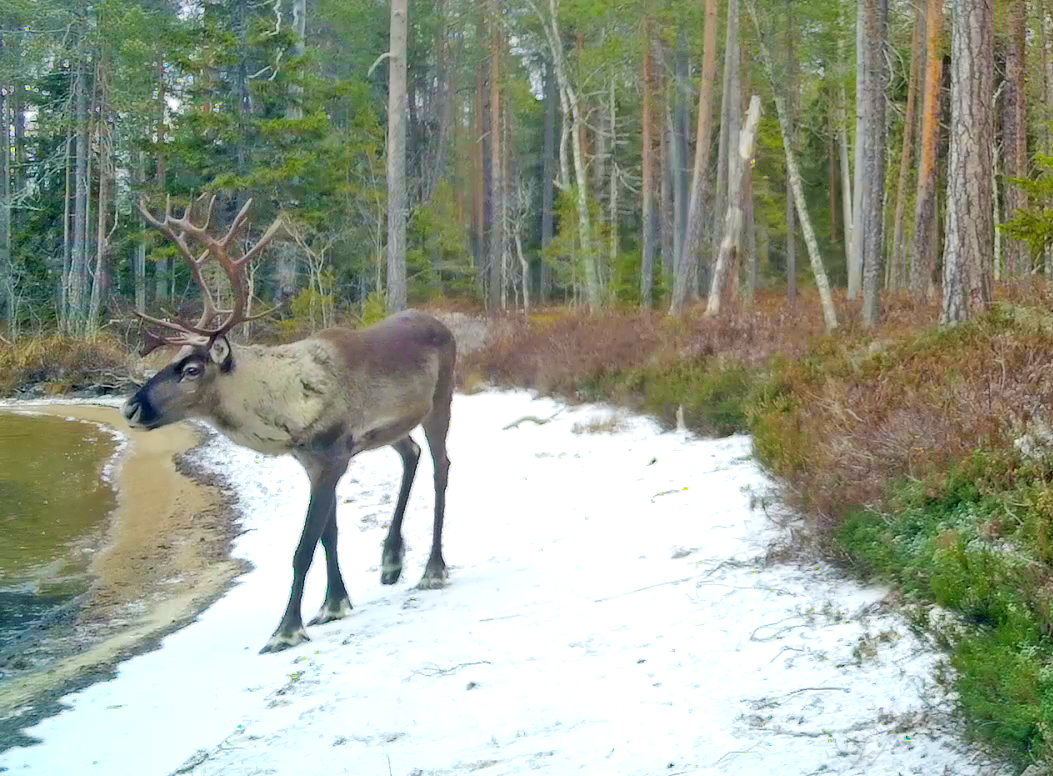
This project was funded by Severstal PJSC, which comprises Karelsky Okatysh JSC within one of its divisions, and is a continuation of a previous study on this subject. Namely, last year the scientists purchased and deployed the equipment for the activities: collared three female reindeer for satellite tracking and placed camera traps in the animals’ habitats.
The location for the work is the Metsola Biosphere Reserve. The project is implemented in collaboration with the Kostomukshsky Nature Reserve and Kalevalsky National Park, which, alongside the Kostomuksha Urban District, constitute the BR. Such observations reveal the habitat preferences of the rare animals. This information is necessary for economic decision-making and for organizing protected areas (PAs). Previously, a study of the Topozero subpopulation in northern Karelia has led the scientists to the conclusion that a PA network needs to be set up in the republic.
– New data on the animals’ movements in the border area can be compared with records available for the Topozero subpopulation. The collars have already yielded interesting observations. In winter, reindeer move extensively, but primarily along the same routes. However, one of our collared females, with a group of other reindeer, moved quite far from their usual grounds and in the course of the winter visited the territories of three Karelian reindeer subpopulations: the Kuhmo-Kamennoe ozero, the Nyukozero, and the Kalevala, – said Danila Panchenko, Senior Researcher at the Zoology Laboratory of the Institute of Biology KarRC RAS.


Danila Panchenko, Senior Researcher at IB KarRC RAS, doing fieldwork. Photos courtesy of the scientist.
Research also continues regarding the human impact on reindeer. While previously the scientists studied how the population is impacted by intensive forestry in the republic, they now plan to assess the levels of pollutants in the animals' bodies. Samples of feces, fur, and antlers will be collected. The content pollutants, including heavy metals, in the samples will be analyzed by the Analytics Laboratory of the Forest Research Institute KarRC RAS.
– The reindeer is an umbrella or indicator species. These terms denote animals whose protection also helps conserve other species in that area. The presence of pollutants in the body of reindeer can also indicate the environmental risks for the region in general, – explained Danila Panchenko.
The first expedition within the project took place in November 2025 near the village of Voknavolok. Scientists deployed camera traps in areas where the animals show up and collected biological samples for analysis.
Danila Panchenko is a member of Severstal’s Biodiversity Expert Board. This is the first advisory body in the Russian metal industry, set up for independent monitoring of corporate biodiversity-related risks. On December 16, the Board had a meeting, where the Karelian zoologist delivered a talk. He noted that one of the expected project outcomes will be practical recommendations for organizations in the mining, logging, and tourism sectors, necessary for the conservation and restoration of the species in the project area.
In 2025, a project on reindeer research, supported by a grant from the Russian Science Foundation, was completed. In this project, researchers studied the formation of the genetic structure of the forest reindeer population under growing human pressure. The disruption of connectivity between reindeer subpopulations by logging and poaching leads to a decline in genetic diversity and the species' viability. An academic article based on this genetic study is being prepared for publication.
Winter is the most challenging time of year for the reindeer. To survive, the animals, including pregnant females, have to tour vast territories. Deep snow makes it harder to escape from predators and poachers, who become more active in the latter half of the season, when the conditions are suitable for chasing ungulates on snowmobiles. Poaching is one of the main threats to the population of this rare species. Experts urge people to report any suspected cases of illegal hunting to supervisory authorities and the Ministry of Natural Resources of Karelia.