



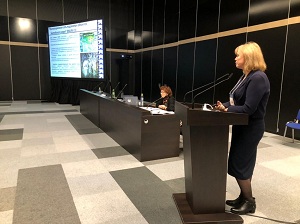
On March 23-24 St. Petersburg hosted the Baltic Sea Days. The agenda of the first day included a meeting of the Russian National Sub-committee (RNSC) of the Interreg Baltic Sea Region Programme, in which President of the Karelian Research Centre RAS Olga Bakhmet is a permanent member.
One of the most noticeable projects in this programme is the “Baltic Sea Underground Innovation Network” (BSUIN, 2018-2020). Its implementation site in Karelia was the Ruskeala Mining Park. KarRC RAS was a project partner. As a result, the conditions were created for setting up an underground laboratory, geophysical monitoring and identification of dangerous jointing zones were carried out, marble and mineral impurities were sampled, the requirements for making tourist routes safe and accessible were determined, and the pre-investment plan for the development of the park was prepared.
This work will continue as integrated geo-ecological monitoring covering issues of geodynamics, geophysics, ecosystems in various habitats. Other plans for 2021 include opening of the Curly birch alley and the Mining Park Museum in Ruskeala.
This year, a new project “European Underground Laboratories” (EUL, 2021) was launched, within which KarRC RAS and Ruskeala will take part in the activities of the newly founded European Underground Laboratories Association.
“SEMPRE Accelerators for Service Co-creation” is another Interreg project in which Karelian Research Centre RAS is a partner. The project focuses on the empowerment of socially challenged groups through their involvement in the development of new social services, and on the creation of social start-ups and enterprises.
Implementing the forestry practices that reduce the input of nutrients and hazardous substances to regional and coastal waters is the objective of the project “Water management in Baltic forests – Tool Box” (WAMBAF-Tool Box). KarRC RAS participates in its Blue Targeting work package: last year, researchers tested in Karelia a technique for assessing the condition of small forest rivers designed by European specialists.
The RNSC meeting discussed the priorities and objectives of the Interreg Baltic Sea Region Programme for the new 2021-2027 phase: resilient and innovative economies and communities; water-smart societies; climate-neutral solutions, products and materials; smart green mobility, etc. The proposals submitted by the Karelian Research Centre in 2019 were taken into account when developing the priorities.
A wide discussion of the programme is scheduled for October, as part of the next international Strategic Planning Leaders Forum 2020-2021. KarRC RAS representatives have already been invited to participate.
KarRC RAS
in social media


in social media
News
March 30, 2021
At a meeting in St. Petersburg, KarRC RAS President Olga Bakhmet presented the organization’s results and plans for the Interreg Baltic Sea Region Programme, including setting up of an underground lab in Ruskeala, testing of sustainable water management tools, activities for and with socially challenged groups, and many other things.